FAST FIVE for the week of November 3, 2013

News:

eCampus Alberta Grows:

The University of Alberta, the University of Calgary, and the University of Lethbridge have joined eCampusAlberta, bringing the consortium’s total number of  post-secondary system member institutions to 19. Online courses from each these institutions will be added to the eCampusAlberta inventory in the near future. eCampusAlberta connects students to more than 900 online courses and 70 programs, and in 2012/13 served more than 11,000 learners for 20,851 course registrations.  New eCampus Alberta members

New CIO:

Athabasca University appointed Mike Battistel as Vice-President of Information Technology & Chief Information Officer (CIO) of the University. Previously, Mike was the VP IS at SMART Technologies, CIO at Ritchie Bros Auctioneers and Versacold Group, and headed the IT departments at Ballard Power Systems, Motorola Canada, and the Open Learning Agency. He has been a national board member with the CIO Association of Canada, and served as president of two of its chapters. Athabasca CIO

Technology Week:

The University of Saskatchewan is holding its annual Technology Week this week. This year the annual showcase of innovation and cyber culture features a keynote address by Ken Steele. Technology Week provides instructors, researchers, staff, and students the opportunity to examine current issues and future trends in information and communications technology. It is a wonderful opportunity for IT stakeholders and consumers to give input into how technology is applied and supported at the University. Tech Week at U of S 

More Space:

Carleton University is increasing the email storage for its students again. Microsoft is upgrading Carleton student email inboxes from 25GB to 50GB. They had recently upgraded student email from 10Gb to 25Gb in June. The web interface is also being updated to be consistent with other Microsoft services. No significant service interruption is expected and the cutover will happen mid-November. Growing storage at Carleton

Mobile student assistants:

Wilfrid Laurier University introduced new mobile assistants to help Library users. This pilot program provides a mobile team of student Library assistants with Android tablets. These roving assistants help users with tasks such as using the self-checkout machines and finding reserve and hold items. They will also monitor noise levels in the Library. According to Scott James, the Library’s desk services manager, “This program means that our student assistants can help you wherever you happen to be in the Library.” Mobility in the Library


Question:

During this period of financial austerity throughout the higher education system, do you see IT taking a renewed interest in production support processes? Without the money to do new projects, do you feel IT has a unique opportunity to concentrate on providing the best operational service possible?

Please forward any comments to mprroman@gmail.com and responses will be published next week.


FAST FIVE for the week of October 27, 2013

News:

IT's boss comes for a visit:

Carleton University's Computing and Communications Services (CCS) department invited their boss to come to work with them. Duncan Watt, VP Finance and Administration at the University, joined CCS's Voice Services department to see what they do on a day-to-day basis. "Take Duncan to Work"

Changing campus-wide login policy:

The University of British Columbia updated its campus-wide login password policy. The new policy requires users to change their password at least once a year. The new policy is designed to follow industry best practices while recognizing the unique circumstances of higher ed. New password rules

Recycling IT:

Seneca College held an electronic recycling initiative designed to encourage staff and students to bring in old electronics to be recycled. Equipment such as laptops, desktops, phones, monitors, and printers were dropped off at their campus bookstore. Green IT at Seneca

Behind the scenes:

The Faculty of Medicine MedIT department at UBC updated video-conferencing equipment in three of its busiest teaching locations in the past year. With no interruption to service, they enhanced collaborative learning, engagement, and presenter capabilities. MedIT upgrade

Response to hacking:

The President of Brandon University took the unusual step of responding with an open letter to a recent hacking attack. The letter reframes the issue quite effectively and is an interesting way to close security and awareness month. Presidential hacking response


Responses to last week's question:

Last week the following question was posed: "Whether MOOCs are successful or not, do you feel they are shifting the conversations and the emphasis in higher ed IT away from administration & research to teaching & learning? Is this a change for the better?"


To answer your question, at UOIT it has always been about teaching and learning.  

A more interesting question though might be with the across the board reduction in funding, where in the future does IT spend its capital (and operating monies for that matter).  

Students are demanding more technology now so that they don't have to "dumb down" when coming to campus;  how is that going to be addressed in a time of declining budgets?  Further, most SIS implementations are ageing and the barnacles are showing; a new implementation will be needed soon and where is that money to be sourced?

Budget time in the future is going to require some very hard decisions.  

Mark D. Naylor, Ph.D., President, Union Hills Enterprises Inc.

I am not a fan of the MOOC hype - there is a place for it, but I have told senior executives that we have other things to focus our limited resources on first. A statement like this makes me rethink that position.   

CIO from a large research university

FAST FIVE for the week of October 20, 2013

News:

LMS usage patterns:

The University of Calgary has published some interested usage statistics about their Desire-2-Learn implementation. The graphs illustrate visits by time of day (midnight utilization is nearly 25% of noon utilization), operating system used by the user (Mac has almost caught up to Windows), visits by day of the week (Sunday is only a little less busy than Monday), and browser type of visitor (Internet Explorer is less than Chrome, Safari, and Firefox). uCalgary D2L

BCIT is alert

The British Columbia Institute of Technology conducted its annual test of its BCIT Alert system recently. The system is used in emergency situations and snow closures to send a short message to mobile devices, email addresses, and voicemail. The annual test sends a message to all registered users. BCIT Alert is used to communicate to the BCIT community in addition to information posted on BCIT websites and other media. Emergency notification

Mobile apps for everything:

Acadia University has a mobile app designed specially their homecoming. The system was built using Yapp, and was designed specifically for this year's homecoming event at the University. Acadia homecoming

Capitalizing on Big Data:

Canada’s federal research granting agencies (SSHRC, NSERC. CIHR, and CFI), have issued a consultation document designed to address digital infrastructure challenges titled "Toward a Policy Framework for Advancing Digital Scholarship in Canada." The document proposes a collective realignment of funding policies to improve data management practices in agency-funded projects. They are asking for stakeholders’ feedback on the document with a deadline of December 16, 2013. Big data feedback

New grade scale:

The University of Windsor has implemented a new grade scale. They have moved to the 100 point scale and updated their student system as well as all related systems. New grades


Question:

Whether MOOCs are successful or not, do you feel they are shifting the conversations and the emphasis in higher ed IT away from administration & research to teaching & learning? Is this a change for the better?

Please forward any comments to mprroman@gmail.com and responses will be published next week.
FAST FIVE for the week of October 13, 2013

News:

3D Distance Learning:

Nipissing University is now using 3D computer technology to support distance learning. By using 3D rendering software, a virtual Nipissing University campus has been created simulating the library, a portion of the main campus, and other areas of campus. The technology is designed to increase the interactivity of online learning. Several pilot projects are underway, including a virtual math drop-in centre. Nipissing in 3D

New Data Centre:

The University of British Columbia is migrating to its new University Data Centre (UDC). The old data centre has become too costly to maintain and will be shut down by mid-2015. In the new UDC, storage is consolidated and re-structured from several storage islands into one storage cluster. This new storage cluster provides the infrastructure with improved scalability, performance, fault tolerance, and manageability designed to meet current and future needs. The new UDC is also energy-efficient, provides updated hardware, and has an improved backup service. New UBC Data Centre

Student System Upgrade:

Simon Fraser University is upgrading its Peoplesoft student information system (SIMS). The upgrade has new features for staff, students, and faculty. Example of new features include: students have new interactive academic progress reports, faculty have a new advisor centre that centralizes information on graduate students, and staff have improved waitlist processes. SFU SIMS Upgrade

CryptoLocker Threat:

A number of Canadian universities have recently been hit by CryptoLocker ransom-ware. It arrives as an email attachment and attempts to extort money from the computer user. When your computer is infected with CryptoLocker, the program begins encrypting any files it can access. Once the files are encrypted it presents the user with a notice giving them a limited time to pay a ransom to get a key to decrypt and access to their files. Currently, infected users are instructed to pay $100 USD to get access to their files. Ransomware Threat

CEO Search:

Compute Canada is again announcing a search for a new President and Chief Executive Officer. The role is responsible for coordinating and promoting the shared use of High Performance Computing (HPC) across Canada. The CEO would lead the creation of a national HPC platform for research and integrate HPC resources across the country. Compute Canada


Responses to last week's question:

Last week the following question was posed: "Privacy laws in some provinces are quite stringent relevant to other provinces. Such legislation makes it difficult for institutions in these provinces to use foreign-based cloud computing and other hosted services. Do you feel this puts these institutions at a competitive disadvantage with the rest of Canada?"

Yes, I think that some privacy related legislation in some provinces puts them at a competitive disadvantage.
 
It is almost universally accepted that Cloud Computing is a more effective way of delivering computing capability (whether infrastructure, platform or software as a service). Some of those benefits come from scale and scale generally means procuring from a North American (read U.S.) provider. In many of those cases (especially SaaS) there is no comparable stand alone Canadian alternative. So mandating that no private data can leave a jurisdiction denies some Canadian organizations the opportunity to leverage those providers, lower their costs, and deliver services more flexibly. (And note that in some jurisdictions “foreign” means outside of the province, further curtailing economies of scale and limiting the likelihood of a Cloud service even being offered).
 
An increasing number of provinces are focusing more on data protection rather than data residency, and if privacy can be reasonably assured in a “foreign” data centre that is sufficient. I suggest that it is important to differentiate between sensitive data and private data, as there is a lot of the latter that does not qualify as the former, and to block any private data from leaving a jurisdiction rather than blocking some (e.g. health records) is throwing the baby out with the bath water. More liberal jurisdictions appear to conclude that Cloud service providers are highly motivated to protect the privacy of all their clients’ data, and often more capable of doing so than organizations who manage their own data are, and that adequate provisions inherent in a subscription agreement are more effective and more relevant than jurisdictional boundaries. Pragmatism is a welcome approach to balancing the tradeoff between the reality of improved and more cost effective service (and indeed privacy protection) for the many against the hypothetical worst case scenarios of the few and the certainty of inefficiency and additional cost that comes with that.
 
Alastair McKeating, Regional Manager, Adaptive Planning

Despite British Columbia having quite stringent privacy legislation, some BC educational institutions have moved to foreign cloud services. Sometimes deliberately and sometimes unwittingly, they have placed personal and private data outside of Canada. By doing so, they introduce several risks to their organizations that are not present in other jurisdictions. Although they do not face immediate penalties, there are longer term risks implicit in these decisions that may place them at a competitive disadvantage in the future. 

For example, BC privacy laws are based on a complaint driven process, which means the government will not stop anyone from moving to any cloud based services. But the government can take action if they receive a complaint. Because of this model some educational institutions have been able to move to U.S.-based cloud email several years ago and have not been shut down. Despite this success, they face an ongoing concern that a complaint could shutdown the service. There is always the potential risk that if their union sees this as outsourcing, they may choose to lodge a formal complaint.

In other cases, higher ed institutions mitigate the risk through an authorization form to be signed by anyone whose personally identifiable information is entered into the system. The challenge with this approach is that a user may choose to decline consent. If they decline, do you support dissenters with a different system (and likely negating any cost savings), or choose to not support them at all?

Mark Roman

FAST FIVE for the week of October 6, 2013

October is National Cyber Awareness Month, so this week's release is dedicated to security and privacy issues.

News:

CIO Security Awareness: 

The CIO at the University of Guelph has initiated a security awareness campaign targeted at keeping private information safe and improving online security for students, faculty, and staff. The goal of the campaign is to raise overall awareness and to reduce the number of compromised accounts. To spread security awareness systemically across the institutional community, all students, faculty, and staff will be enrolled in a security awareness course on Courselink. University of Guelph

Daily Tips:

At Seneca College, the Information Technology Services (ITS) department is providing tips throughout the month of October to improve cyber awareness. Their awareness approach is intended to get the community to think about the security of computers and electronic devices, and what they can do to improve it. The first week of the campaign covered mobile security and this week the tips are focusing on phishing. Seneca College

Security Resources: 

At Carleton University, members of the community are reminded of the security services and resources available from the Computing and Communication Services department. Their site includes tips on how individuals have a responsibility in improving IT security, how to protect themselves online, and how to protect their computer against viruses. They also provide some links to external IT security resources. Carleton University

Anti-Virus Software:

Memorial University provides information about their anti-virus software services. They provide virus protection for University owned computers as well as free anti-virus software for home use. These options are available for faculty, staff, students, and alumni. Everyday is a MUN-day

Mobile Security:

The University of British Columbia has a site dedicated to Mobile Security. It reminds users of their obligation to protect personal information that may be stored on their devices and provides a series of resources explaining how to keep the information on their mobile device safe if it is lost, stolen, or hacked. University of British Columbia


Question:

Privacy laws in some provinces are quite stringent relevant to other provinces. Such legislation makes it difficult for institutions in these provinces to use foreign-based cloud computing and other hosted services. Do you feel this puts these institutions at a competitive disadvantage with the rest of Canada?

Please forward any comments to mprroman@gmail.com and responses will be published next week.

FAST FIVE for the week of September 29, 2013

News:

Defining IT: 

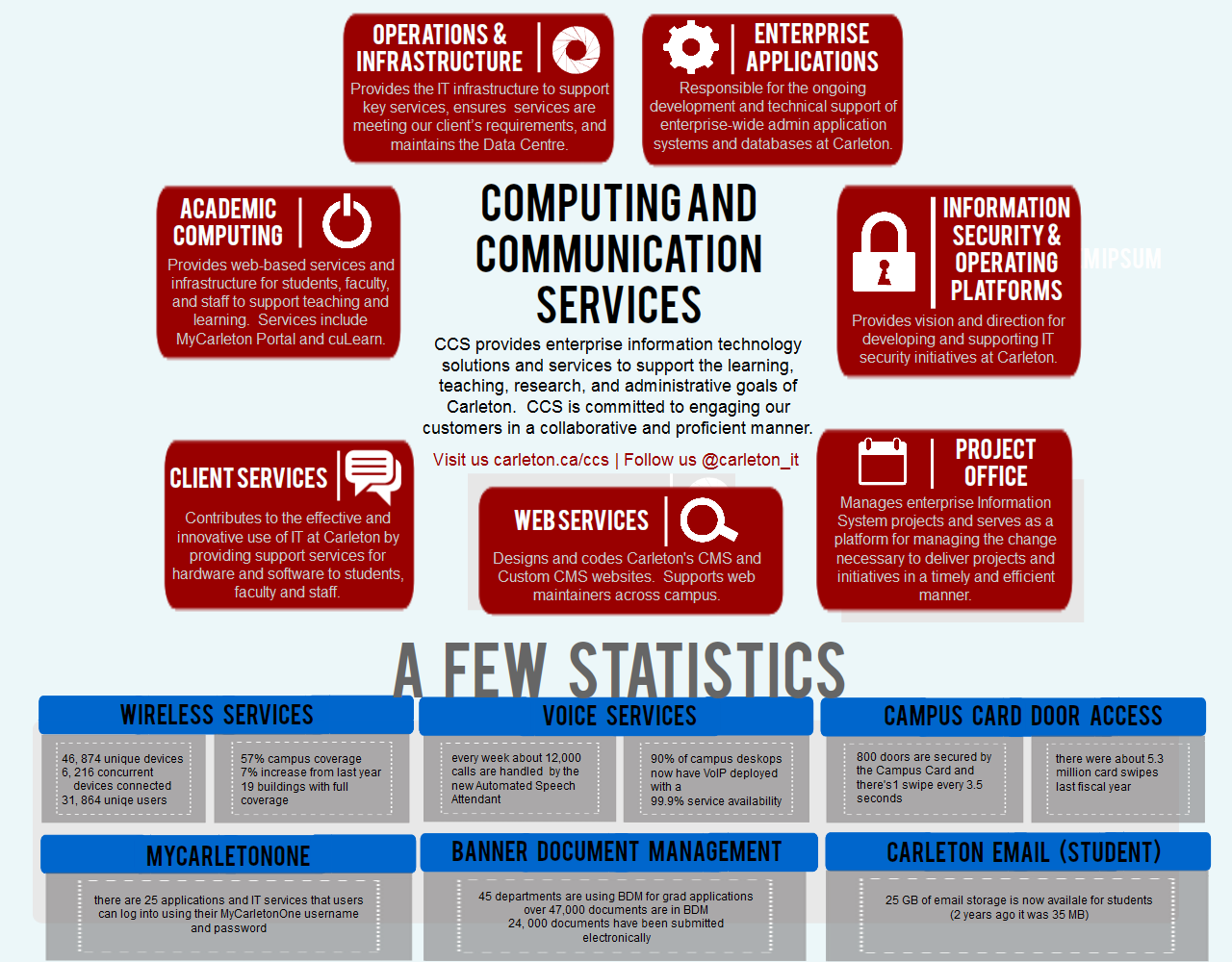
Carleton University has published an infographic defining its core services, mission, and vital stats. Computing @ Carleton

New look: 

The University of Toronto's IT Services department web site has a new look. With a prominent search field, latest news bar, and system status button, the site is clean and efficient and makes Google look like a mere search engine. UofT IT Services

IT recycling games:

Queen's IT Services, in conjunction with the University's Sustainability Office, is running its second annual Recycle IT Games. The Games feature events like laptop toss and cellphone accuracy throw, and provide a fun way for the Queen’s community to recycle its unwanted electronics. Last year’s games collected and disposed of nearly 3.5 tonnes of e-waste, including 2,179 kilograms of computer towers and 590 kilograms of monitors. That’s more than 10 percent of the e-waste that Queen’s recycled last year. Queens recycles IT

Top mobile app in Canada:

The University of Saskatchewan’s mobile app iUsask was named the number one app for navigating Canadian universities according to Connected Rogers, a Canadian technology and lifestyle digital magazine. uSask mobile award

Active learning technology transformation: 

Several classrooms at Queen's are being re-designed to become active learning spaces. The classrooms are designed to encourage different types of learning by installing varying levels of technology. Each of the new classrooms will feature a different configuration. The attached link shows some of the technology in these new classrooms and how they were built. Classroom eLearning changes


Responses:

Last week this question was posed: "Has IT lost its relevance in higher education? In a recent IT conference several speakers expressed concern that the constantly declining budgets in higher ed IT are a sign of declining relevance to their institutions. Do you agree or disagree? If you agree, what would you do about it?"

Several responses were received:

I would suggest that it is a shifting relevance. Many of our IT organizations have evolved over the past several decades to become all things to all people. As a result, our ‘business model’ has become unsustainable in an era when government funding is being reduced and technologies are increasingly personalized, mobile and self-empowering. Cloud computing has certainly had an impact, too, as it changes the delivery and support models in fundamental ways.

Strong and flexible organizations focus on core competencies and let go of activities that have decreasing value. That is the challenge facing us in IT services. We need to migrate away from provision of commoditized IT services and shift focus to higher-level services such as data analytics, information services, systems integration, business analysis and project management. Those services are desperately needed by our organizations.
We need to shift in this direction if we wish to remain relevant.

Dwight Fischer, CIO Dalhousie University

We are caught between traditional one-year budget and 5-year amortization administrative cycles on the one hand and technology flavour of the week/month on the other – so at best there is stress in the system.

I think though that the question is too broad – IT is too wide a scope.  I think we need to look at the various levels of service we provide and recognize that they range from – commodity/consumer up through mandatory operations to systems that help us compete by differentiating us all the way to innovation.  The commodity/consumer stuff of today was the innovation of yesterday – so IT needs to recognize that and “let it go” – in fact develop a process and a culture of “letting it go” so that we can focus more on the things that really make a difference (however fleetingly) for our universities.

Graham C. Mowbray, CIO Memorial University

If ‘IT’ is defined as a group of people who are good at configuring hardware and software. Then yes, IT is losing its relevance in higher education (and, so it should!). If the IT group views itself (and presents itself) as a back office function, it will increasingly be marginalised. Skills that used to be associated with an IT professional are drastically changing. The stereotype of the socially awkward technically savvy IT guru are giving way to a new paradigm – that of a highly focused and engaged person who is a strong communicator capable of translating complex business needs into viable enabling solutions. 

If ‘IT’ is defined as a key business enabler advocating for the use of technology in appropriate contexts then I think that IT is gaining relevance rather than losing it. IT as an industry is so young that old paradigms were stages in the infancy of the profession. Thus the new label of Information and Communication Technology (ICT). When used strategically, ICT is emerging as a business transformation pillar. A highly relevant ICT service unit is one that is an expert in the ‘business’ that it supports. It is also one that sees itself as offering services in change management – helping people discover new ways of working towards achieving higher value. After all, if nothing else, our industry is about change.

Dave Lampron, Director Technology Enabled Learning MedIT, University of British Columbia 

FAST FIVE for the week of September 22, 2013

News:

Online U: 

The University of Fredericton has completed its first full year using WebEx (from CISCO) to deliver all its live, online courses to students. uFred delivers all its course content and lectures exclusively through through this system. The University held over 1,000 live, faculty-led classes in the 2012-13 academic year and all of the classes were recorded and made available to students and faculty for future use. WebExclusive

Text messaging: 

Centennial College has a new free text messaging services for students. The system is delivered through Galaxy Text and standard message and data rates may apply for text message alerts and announcements sent to, or from, the service. Users are guaranteed to receive no more than two messages per week and the vendor commits to keeping all contact information confidential. Student texting

Digital signage: 

The University of British Columbia has a Digital Signage Program managed under the direction of UBC IT and Communications & Marketing. The system is designed to provide the visual and technical architecture required to share diverse messaging consistently across the University from a central source. This integrated system provides the functional capacity to deliver campus updates and emergency information. UBC signs

eCommunications:

The University of Toronto is launching a project consultation process with faculty and staff for eCommunications. Over 105,000 students and alumni have successfully migrated to the Microsoft eCommunications cloud services and the institutional tools available to most faculty and staff now lag behind those cloud services.  The University's Information and Technology Services group has begun examining the potential of extending such eCommunications tools to their full community. UofT Microsoft consultation

LMS for Med School:

The UBC Faculty of Medicine IT group has successfully transitioned to the new MEDICOL (Medicine and Dentistry Integrated Curriculum On-Line) learning system this August. This new system provides access to all resources and curricular materials for learners, faculty, and staff affiliated with the MD undergraduate program. Key features include a portal, a learning management system, and a learning object repository. In addition to designing and setting up a new system, the project team migrated all of the existing content and documents for Years 1 to 4 of the MD undergraduate program. MedIT implements new LMS


Question:

Has IT lost its relevance in higher education? In a recent IT conference several speakers expressed concern that the constantly declining budgets in higher ed IT are a sign of declining relevance to their institutions. Do you agree or disagree? If you agree, what would you do about it?

FAST FIVE for the week of September 15, 2013

News:

Mobile app in New Brunswick: 

The University of New Brunswick (UNB) launched its first, university-wide, mobile application for smartphones and tablets. The app is available for Apple iOS and Android devices. It fully integrates with the university’s core IT systems, enabling access to personal information for students such as class schedules and, later this fall, exam schedules and grades. The app also includes features such as a secure UNB phonebook search that integrates with the device’s contact information application.  UNB Mobile App

Mobile app in Manitoba:

The University of Manitoba has also launched a mobile app, the first higher-ed app of its kind in the province. It is available for Apple iOS and Android devices. The app is designed to support the broad University of Manitoba community, but focuses primarily on enhancing student experience. Features of the app include: news, events, directory, grades, schedule, library search, transit, new students resources, campus maps, and emergency contacts. uManitoba mobile app

Law student technology survey:

The 10th annual University of Victoria Law Student Technology survey was completed with a strong 90% plus response rate. The survey has a number of interesting statistics, such as 92% of Law students use Skype for real-time audio/video calls and collaboration, whereas 42% use Apple Facetime and 9% use Google Hangouts. For more interesting facts, follow the link. Law survey

Expanding help:

More news from the University of Victoria where the Systems team and the Computer Store have opened a new computer help desk location inside of the computer store within the Bookstore.  This location will enhance the service provided to students, faculty, and staff by helping clients to find the right technology to meet their needs, offering device setup assistance, and troubleshooting technical issues. More help

Canadian Ellucian Users Conference:

The annual Canadian Banner Users Conference has been replaced this year by the new Canadian Ellucian Users Group conference. With the merger of the Banner and Colleague systems ownership into a single vendor, the user communities are coming together for the first time to share knowledge and experience of enterprise administrative systems. CEUG 2013


Responses:

Last week this question was posed: "A recently published article from Inside Higher Ed indicates 12% of CIOs are assuming responsibility for campus libraries. What is your opinion of this trend?" 

Two responses were received:

It makes perfect sense for libraries to align with the CIO portfolio:
  1. Libraries are going through a transformation. The old function of a library is now largely being accommodated virtually. The spaces that libraries occupy are changing, going from a 'shushing' quiet zone to an interactive and engaging place for active learning (often in a group setting).
  2. After all, the CIO portfolio is about 'Information'. I can't think of a place more synonymous with information than a library.
Dave Lampron, Director, Technology Enabled Learning, MedIT, UBC

Be careful what you ask for, you might get it! I was responsible for the library at one of my former institutions and the experience, while rewarding in some ways was nevertheless, quite a challenge. If the Chief Librarian is a forward looking individual who embraces the digital revolution in libraries (80%+ of the resources at my previous institution's library are digital) then the synergy between IT and the Library may be very productive. Unfortunately this is not always the case.  

Mark D. Naylor, Ph.D., President, Union Hills Enterprises Inc.

FAST FIVE for the week of September 8, 2013

News:

Unsung heroes: As students arrive back on campus this month and systems are straining to meet additional volume and new demands, help desks across the country are working overtime to provide support. The help desk team at the University of Victoria has received some wonderful praise from its clients: Recognition for great service

Social strategy: The British Columbia Institute of Technology has implemented an enterprise social networking system. The attached article describes some of the changes in attitudes needed to make the shift: New system / New culture

Making transfers easier: University of Toronto has released a new transfer credit system. This system is part of its student web service and allows students to check the eligibility of courses taken at other Canadian post-secondary institutions for transfer to the UofT. The tool also includes transfer credits among faculties at any of the Mississauga, downtown or Scarborough campuses. Transfer credit check

Adding bandwidth: Wilfred Laurier University has increased its external network connectivity from 1Gb to 10Gb through its ORION link. http://www.wlu.ca/news_detail.php?grp_id=0&nws_id=11524

Self-serve passwords: Algonquin College has introduced a new system called MyPass to allow faculty, staff, and students to change their own network password. This self-serve system will reduce calls to the help desk. Password changes

Question:

A recently published article from Inside Higher Ed indicates 12% of CIOs are assuming responsibility for campus libraries. What is your opinion of this trend?

The article is here: CIOs Wear Second Hat

Please respond to mprroman@gmail.com and I will post comments next week. Thanks!

FAST FIVE for the week of September 1, 2013

News:

New mobile app: Memorial University has just released a new mobile app. Available for Apple and Android devices, the system includes a campus map, student services, contact information, and latest news at the University. The system uses the Ellucian Go technology to distribute the app. MUN goes mobile

Improving the campus alert system: The University of Windsor has updated its emergency alert system to show the University's main phone line. The original system displayed the phone number of the company that built the system, and some users never responded because they thought the calls were coming from telemarketers. New alert phone display 

Implementing VDI: Sheridan College is implementing a Virtual Desktop Infrastructure project. Their key goals in the first phase include providing a standard desktop environment in labs, in learning commons areas, and in a pilot group of administrative users. They intend to replace end-of-lease PCs with VDI workstations and hope to reduce energy consumption by 40% with these devices. Sheridan's VDI

Computer lab upgrades: Like many educational institutions, the University of New Brunswick has upgraded its student labs over the summer. They have passed on the new information to their students in a simple tweet: UNB lab changes

Upgraded email accounts: The University of Victoria has introduced enhanced role-based email accounts. These new accounts are no longer limited to 8 characters and may take the form of department.name@uvic.ca. These new accounts are useful for departments, shared email accounts, and conference. Role-based email


Responses to last week's question:

Last week, this question was posed: "If you had to teach a course in the management of IT in higher ed to first year students, what is the single most important issue you would tell them?" 

I received several responses and I think the ideas are equally applicable to 1st year students and veteran CIOs: 

To first year students, I would expect them to think that IT was all about technology but I would counter that IT was about people, those who provide it and those who consume it. To me this was not obvious when I entered the profession and I still encounter those who haven't yet learned that tech is easy if you put people first, those who are your clients and those who provide the service(s). Mark Naylor PhD, President, Union Hills Enterprises

Make the effort to understand the business needs of your user community. A lot of what seems like strange behaviour is actually rooted in frustration with IT applications designed in isolation that don’t support how business users work. If you can understand the business you can learn to express the business value of IT initiatives in terms they will understand and buy into. But also recognize that as a role that transcends numerous business silos you have a unique perspective that they don’t have on how data is shared across functions, organizations and processes. Learn how to express the value of a comprehensive approach but know how to trade off tactical choices in a strategic framework. And yes, that’s easier said than done. Alastair McKeating Regional Manager, Adaptive Planning
I would tell them that the single most important issue is in relating IT to the business of Higher Education and vice versa and getting the funding model right.  IT is different than anything else in history and needs new rules.  It's NOT a utility, it's treated like one sometimes, but it develops much more quickly.  It's not a tool, it's treated like one sometimes but it's much more embedded and ubiquitous.  It's not a service, it's treated like one sometimes but also has the ability to lead the business.  It's an enabling force like nothing that has ever come along before, and needs to be valued and treated that way. John Porter, Manager Residence Technology, Queen's University

Honesty and ethics. Ian McLeod, CIO, Douglas College

I think the most important issue we face is considering what the role of corporate IT (and especially the CIO) will be in this changing world where pretty well every business process and customer interaction has a digital footprint. Brian MacKay, AVP IT Services and CIO, Thompson Rivers University